By Dan Cooper, Count Compiler
The Los Angeles Christmas Bird Count was held on Jan. 2, 2026, the original date (Jan. 4) having been moved due to the predicted all-day rain. Most of our regular counters were able to switch to the new date; interestingly, only a few new participants made it out on the 2nd (but a big thanks to those who did!).
Observers submitted 99 checklists (roughly equal to prior years). Each year, we have most of the same areas covered by roughly the same people. Our species total this year (175 native/naturalized species) was identical to the prior year, which was almost the same as the year before (175 in Jan. 2025, 176 in Dec. 2023). Recent totals have hit 187 (both Jan. 2022 and Jan. 2021). I’ll be comparing this year’s observations with a 45-year dataset of prior year’s CBCs in the same count circle.
Rare geese were again rare, with no Cackling, Ross’ or Snow geese, and (again) just a single Greater White-fronted Goose (Ballona Freshwater Marsh).
Most other waterfowl were found in low numbers, with singles of both Red-breasted Merganser (mean 14) and Hooded Merganser (mean 17). The Hooded wasn’t at an inland lake where expected, but in the little urban park at Playa Vista. A few ducks were up, however, like Gadwall with 48 counted (mean 34).
Five different parties found 44 California Quail, which was encouraging compared to recent years with single digits; we had counts of 100+ until 1999.
The great hummingbird face-off continues, with 181 Anna’s and 469 Allen’s, holding steady with a little more than 2:1, Allen’s to Anna’s.
We managed to miss both the Pacific Golden-plover which had been wintering along Ballona Creek, as well as any Snowy Plovers on local beaches, though our beach effort suffered due to lack of effort. Thirty or so Bonaparte’s Gulls around Playa del Rey were a nice surprise, but no crazy gulls were found.
Owling paid off with a couple Common Poorwills and four Barn Owls in Griffith Park
The only sapsucker found was a lone Red-breasted at Franklin Canyon; I don’t think anyone tried for the female Williamson’s hanging out in residential Studio City (a few Count Week rarities were around, like the Black-throated Green Warbler at Clark Library in West Adams, and either missed or just not looked for).
Our Yellow-crowned Night-heron roost in Marina del Rey grew to 21 (17 last year), again staked-out on private property.
Counts of Sharp-shinned Hawk (2) and Merlin (3) were low; the six American Kestrels reported were well below the average of 17, but we may never reach those earlier numbers again – the species needs fairly large, grassy or weedy patches of land to forage in, and these are rarer each year in the circle. We had four Peregrines, but oddly, none along the immediate coast; the two at USC look like they’re nesting on a high building on campus.
A Western Kingbird at Ballona Freshwater Marsh is wintering, and rare in that role in the region.
A Plumbeous Vireo, often missed, was at Ladera Park.
Montane irruptives were virtually nonexistent, and Griffith Park again produced our only Mountain Chickadee (1), and zero Red-breasted Nuthatches or siskins. Four Purple Finches were scattered around.
Just one swallow species was found (Barn), along the coast at Playa del Rey.
Red-whiskered Bulbuls numbered five, found at UCLA, Beverly Hills, and Coldwater Canyon Park. Swinhoe’s White-eyes continue to explode, with 27 found (18 last year, and annual only since 2019).
Mockingbirds are still down (88; 149 is our recent average).
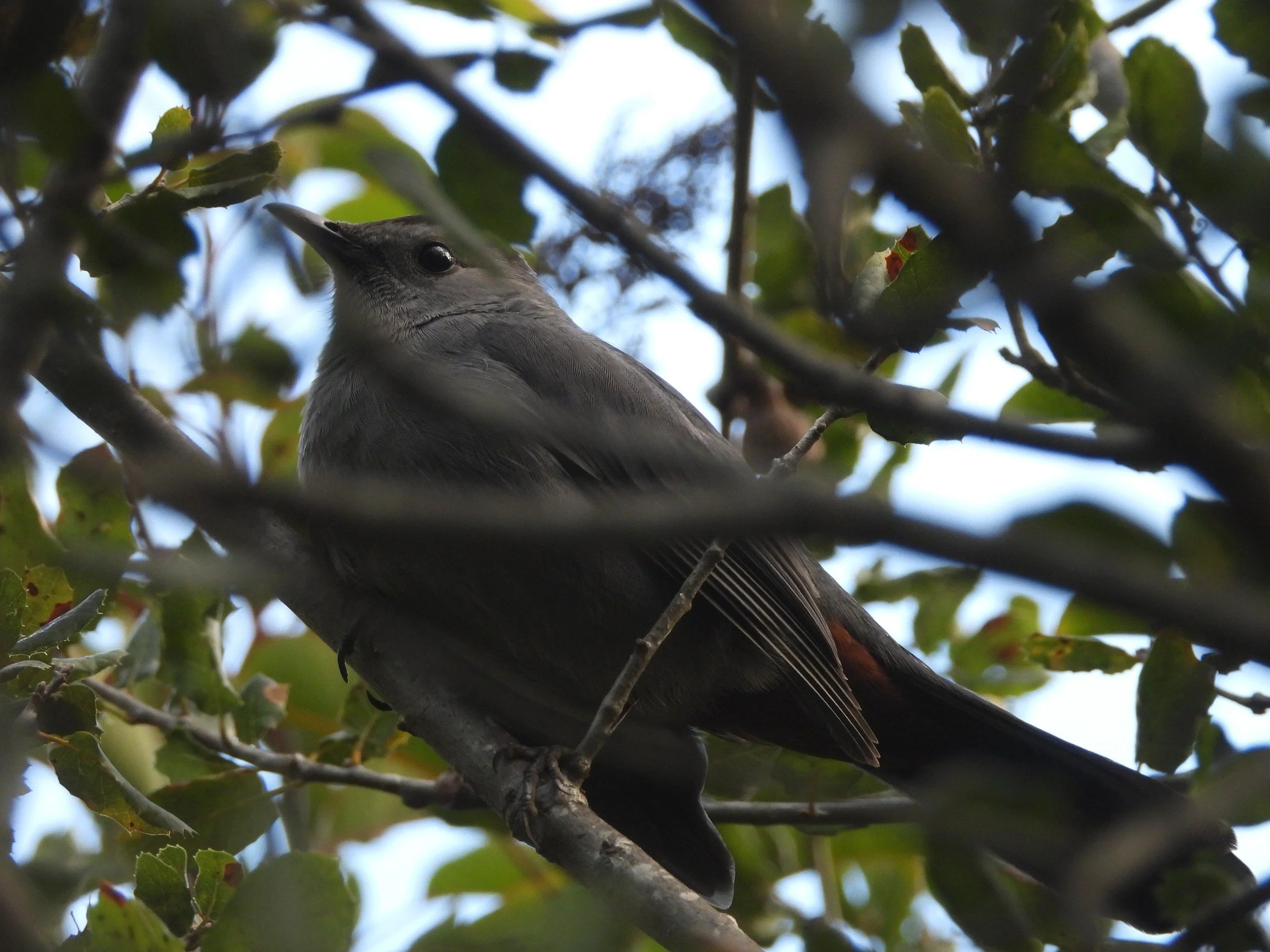
A remarkable Gray Catbird – new for the count – obliged at UCLA, where it’s been wintering.
American Robin bounced back big, with 536 tallied (just 7 were seen last year), and the 1,209 Cedar Waxwings found were almost 3x the last two years. Three Phainopepla were in the Baldwin Hills, where regular.
California Gnatcatchers are now established along the Westchester Bluffs near Ballona Freshwater Marsh, and were found there on count day. A Canyon Wren in Griffith Park was a nice “get”, as we’ve only found it five other years since 1980 (though it appears to be resident in the park – you usually just need a good ear to pick out its call from distant rocks since they rarely sing in mid-winter).
Grassland birds are still around but still declining – the 10 Western Meadowlarks at Holy Cross Cemetery near Culver City were the only ones for the count (i.e., none were found at Ballona).
A Clay-colored Sparrow at humble Pan Pacific Park was a known wintering bird and a good find on count day, being recorded on only 2 other counts since 1980. Another rare sparrow was the Swamp Sparrow found at Echo Park Lake, a beneficiary of all the freshwater marsh vegetation that’s been allowed to develop there in recent years. Just two “non-Oregon” Dark-eyed Juncos were found, a “Slate-colored”-ish bird at Westchester Park, and a very rare “Gray-headed” form at tiny Poinsettia Park in West Hollywood.
Song Sparrow numbers continue to skyrocket, we found 254, compared with a recent mean of 61.
Two oriole species were found – one Hooded and three Bullock’s, all in the Culver City/West L.A. area.
The Cape May Warbler again returned to LMU, and a rare Rose-breasted Grosbeak, also wintering near LMU, was picked up on count day. The team at UCLA located a rare Hermit Warbler (found in just 8 other years since 1980); other uncommon warblers seemed especially rare – just one (northern) Yellow Warbler was found, at MacArthur Park. Only three Western Tanagers were detected, narrowly edging out the two (usually much rarer) Summer Tanagers found at UCLA and Village Green.
Other singletons found included Common Goldeneye (Silverlake Res.), Dunlin (Ballona), (Hudsonian) Whimbrel (yes, just one, at Ballona), Rufous-crowned Sparrow (Hollywood Reservoir), and “Myrtle” Yellow-rumped Warbler. As for my own (very) briefly-seen “Large-billed” Savannah Sparrow along Ballona Creek, I dunno – it did have a large bill and dull streaks throughout, but no one has seen it since. Oh well, that’s birding for ya.