The Rann of Kutch is a vast area of salt desert / salt marsh located in the north-west of the Indian State of Gujrat. It borders the Arabian sea on the west, the Indus river delta to the north and stretches east for about 250 miles. It is split into the Great Rann and the Little Rann, somewhat loosely, based on ability to access and administer the vast region. It is arguably the largest salt desert / marshland in the world, covering an area of about 10,000 sq. miles. Desert or marshland?
Rare Bird Alert - July 11, 2020
Birding Notes from the Ebell Club, 1917
The regular meeting of the department of California History and Landmarks [of the Ebell Club] met on April 26 [1917] …
Miss Phillipson introduced Mrs. Harriet Myers, secretary of the Audubon Society and chairman of the Department of Birds, Wildlife and Flowers of the General and State Federations [of Women’s Clubs]. Her subject was California birds.
Rare Bird Alert - July 3, 2020
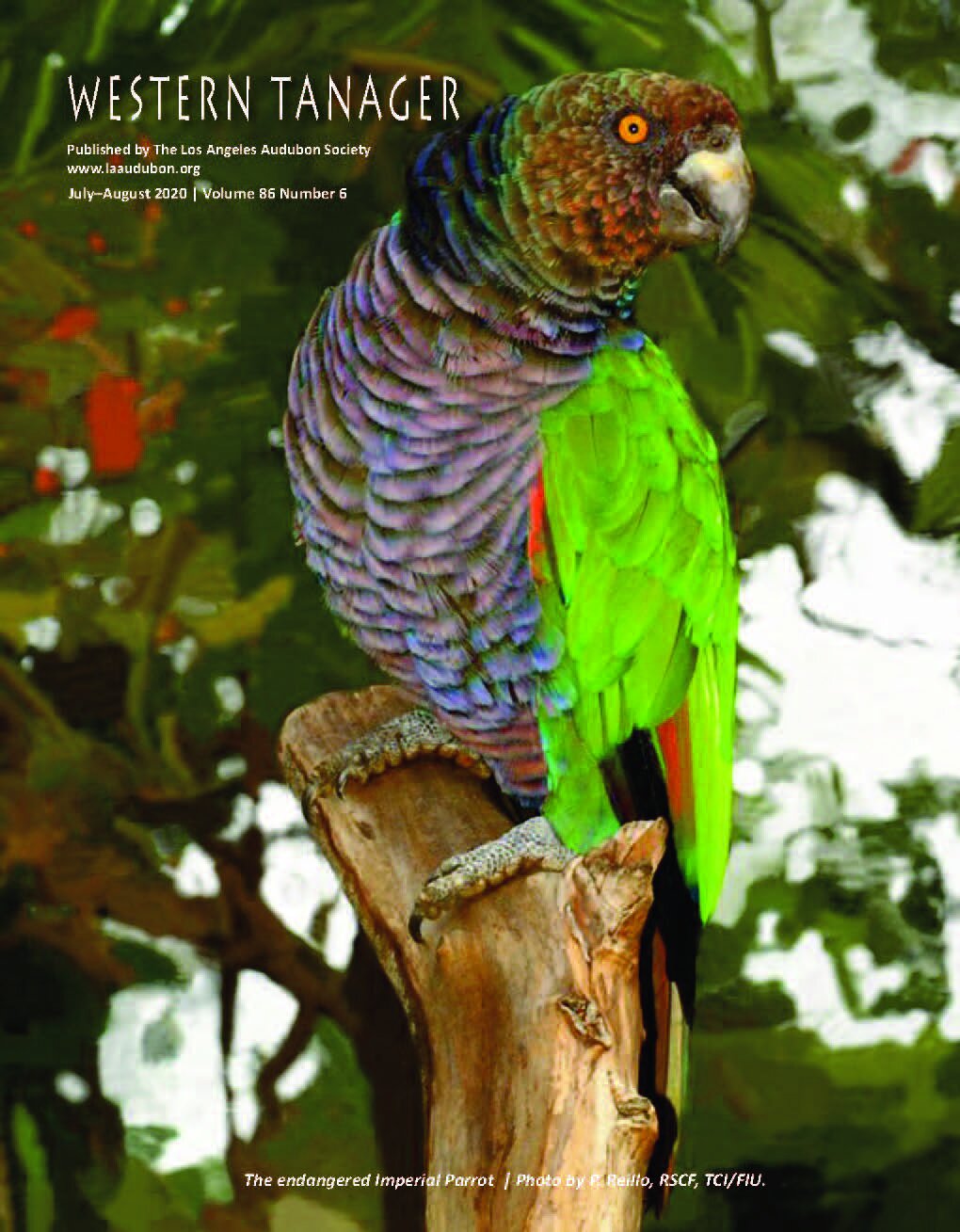
Western Tanager, Vol. 86 No. 6, July–August 2020
The endangered Imperial Parrot | Photo by P. Reillo, RSCF, TCI/FIU.
INSIDE THIS ISSUE
WINGING IT—Discovering the Caribbean Birding Trail, Part II, Dominica — The Rare Parrots' Paradise | By Robbie Lisa Freeman
BIRDS OF THE SEASON — June 2020 | By Jon Fisher
YOUNG BIRDERS—Charismatic and Clever: The Cactus Wren (campylorhynchus brunneicapillus) | By Dessi Sieburth
OUTDOOR EDUCATION—Experience & Perspective | By Cindy Hardin
INTERPRETING NATURE—Making Connections Between Birding and Food Gardening | By Ingrid Carrillo
CONSERVATION CORNER—Rio de Los Angeles State Park Riparian Breeders | By Andy Birch
FROM OUR READERS
Top Ways To Preserve Nature While Hiking, by Rachel Gaffney
Photo Essay — India Journal: December 2019, by Rustom Jamadar
The Fledgling, by Brenda Rees
Owls Nesting in Our Yard, by Janice Rayman
Reclaiming Ourselves Through Nature, by Danny Humphrey
Two Robins in a Birdbath, by Janine Soucie Kelley
No Sparrows, by Annie Margis
Birding Notes from the Ebell Club 1917, by Judith Thompson
POEM: Ballona Stories, by Joyce Karel
FROM OUR READERS: Top Ways to Preserve Nature While Hiking
CONSERVATION CORNER: Rio de Los Angeles State Park Riparian Breeders
Once in a while, it’s good to celebrate a conservation success story on public land, right in the heart of the city. Rio de Los Angeles State Park appears to be a real success story in terms of re-wilding a small section of a park that sits within an intensely urbanized setting. The park is located in northeast Los Angeles, approximately 2.5 miles north of downtown and is located next to the former Union Pacific Rail Yard called the Taylor Yard complex, which is also under active long-term planning as a city park.
FROM OUR READERS: BALLONA STORIES - A Poem
FROM OUR READERS: No Sparrows
Being visited by wild birds while working in my outdoor office is an invigorating momentary distraction from my labors. Every morning before I plug in on the patio table, I open my rodent-proof bird food container and scoop out seeds. nyjer for the goldfinches, corn for the sparrows, black sunflower seeds for the mockingbirds, suet for whatever bird comes to call, plus sugar-water for the hummingbirds.
FROM OUR READERS: Two Robins In a Birdbath
Not exotica that you would grab your bins, rev-up your SUV and drive across three states to observe, beaming with pride as you record its sighting and count on eBird. Rather the robin is a friendly bird, more like a next-door neighbor.
You won’t have to trek to the Amazon or Patagonia to see a robin, though once-in-a-lifetime trips like those are inked on many a bucket list. No. You will spy the robin in Ponderosa pine forests, urban landscapes and grassy lawns pecking the ground for earthworms. Her nest is made of mud, her eggs an eponymous and beautiful blue that you just might decide is the perfect color for your kitchen.